In the world of fluid dynamics and pump engineering, few concepts are as critical as Net Positive Suction Head, or NPSH. Understanding NPSH is fundamental to ensuring the efficiency, reliability, and longevity of any pumping system. Neglecting this parameter can lead to a destructive phenomenon known as cavitation, which can severely damage pumps and result in costly unplanned downtime.
What is meant by NPSH?
Net Positive Suction Head (NPSH) is a measure of the absolute net head present in a liquid at the suction inlet of a pump. It represents the residual energy of the liquid relative to its vapor pressure. Although derived from pressure values, it is always expressed as a head (energy per unit weight), typically in meters (m) or feet (ft).
To truly understand NPSH, one must first understand vapor pressure. This is the pressure at which a liquid begins to boil and turn into vapor at a specific temperature. If the energy in the suction line drops below the liquid’s vapor pressure, bubbles will form. This is the genesis of pump cavitation.
Available NPSH (NPSHa) vs. Required NPSH (NPSHr)
The concept of NPSH is divided into two key parameters that form an energy balance:
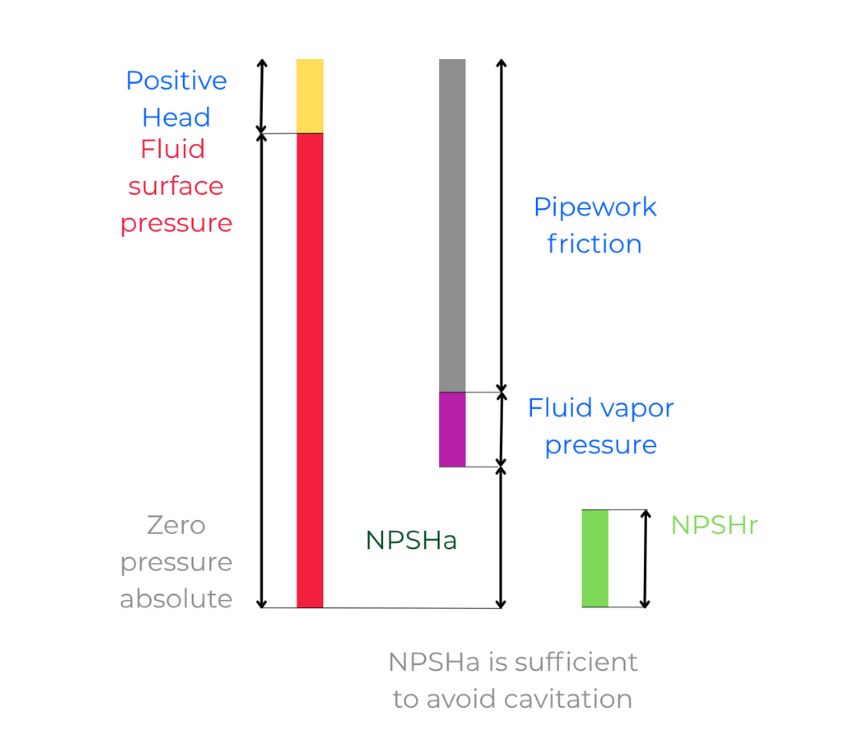
- Available NPSH (NPSHa): This is a characteristic of the system. It represents the absolute head actually available at the pump’s suction inlet. It is determined by the geodetic head, friction head losses, and the absolute pressure acting on the surface of the liquid, vapour pressure of pumped fluid at the relevant temperature. In other words, the NPSHa depends on the plant layout and the properties of the fluid at that temperature.
- Required NPSH (NPSHr): This is a characteristic of the pump. It is the minimum head required at the suction inlet to prevent cavitation. This value is determined by the pump’s design and is provided by the manufacturer for various flow rates.
The fundamental rule:
NPSHa must be greater than NPSHr. The available NPSH in your system must always be greater than the NPSH required by the pump. A safety margin of at least 1 meter is recommended.

Calculating NPSH:
A PRACTICAL GUIDE
While pump manufacturers provide the NPSHr, system designers are responsible for calculating the system’s NPSHa. The formula for NPSHa is:
NPSHa = Hp +/- Hs – Hf – Hvp
Where:
- Hp (Absolute pressure head): The energy derived from the pressure acting on the surface of the liquid. In vented systems, this is atmospheric pressure; in closed systems, it is the absolute pressure head within the vessel.
- Hs (Geodetic head): The vertical distance between the liquid surface and the pump centerline. This value is positive for flooded suction and negative for suction lift.
- Hf (Friction head loss): The energy lost due to friction as the liquid flows through the suction piping and fittings.
- Hvp (Vapor pressure head): The liquid’s vapor pressure at the pumping temperature, converted into a liquid height.
The dangers of insufficient NPSH: Cavitation
When NPSHa drops below NPSHr, the suction pressure falls below the liquid’s vapor pressure. This causes vapor bubbles to form, which then collapse violently as they move into higher-pressure regions. This collapse creates shockwaves that cause:
- Erosion and pitting of the impeller and pump casing.
- Excessive noise and vibration (often described as pumping gravel).
- A significant drop in pump performance (head and flow rate).
- Premature failure of mechanical seals and bearings, or damage to the mag drive pump support structure.
Factors affecting NPSH
Factors affecting NPSHa (System-dependent):
- Liquid temperature: Higher temperatures increase vapor pressure (Hvp), reducing NPSHa.
- Altitude/Surface pressure: Higher altitudes or vacuum in the tank reduce Hp and thus NPSHa.
- Geodetic head: Increasing the liquid level in the supply tank increases NPSHa.
- Piping design: Longer suction pipes and smaller diameters increase friction losses (Hf), reducing NPSHa.
Factors affecting NPSHr (Pump-dependent):
- Pump speed: Higher pump speeds increase NPSHr.
- Flow rate: As flow rate increases, NPSHr also increases.
- Impeller design: Geometry significantly impacts the required value.
How to improve NPSH and prevent cavitation
To increase NPSHa:
- Increase the liquid level or raise the suction tank.
- Lower the pump’s position relative to the liquid level.
- Increase the diameter of the suction piping.
- Minimize the length of the suction line and the number of fittings.
- Pressurize the suction tank (if closed).
- Cool the liquid to lower its vapor pressure.
To decrease NPSHr:
- Choose the right pump with a low NPSHr at the operating point.
- Use a larger, slower-turning pump.
- Reduce the speed using a Variable Frequency Drive (VFD).
ENGINEERING FAQ
- Is NPSH a head or a pressure? NPSH is a head, which is a measure of energy per unit weight of fluid. The geodetic head (Hs) is strictly the elevation component of the total energy.
- Why is using gauge pressure incorrect? Cavitation is governed by vapor pressure, an absolute fluid property. Using relative pressure ignores the energy contribution from atmospheric pressure or vessel pressurization.
- What happens under vacuum? In vacuum systems, the Hp term is significantly reduced. To maintain NPSHa, the positive geodetic head (Hs) must be increased.
- Why does cavitation sound like pumping gravel? The sound is produced by high-energy shockwaves resulting from thousands of vapor bubbles collapsing against the impeller at sonic speeds.